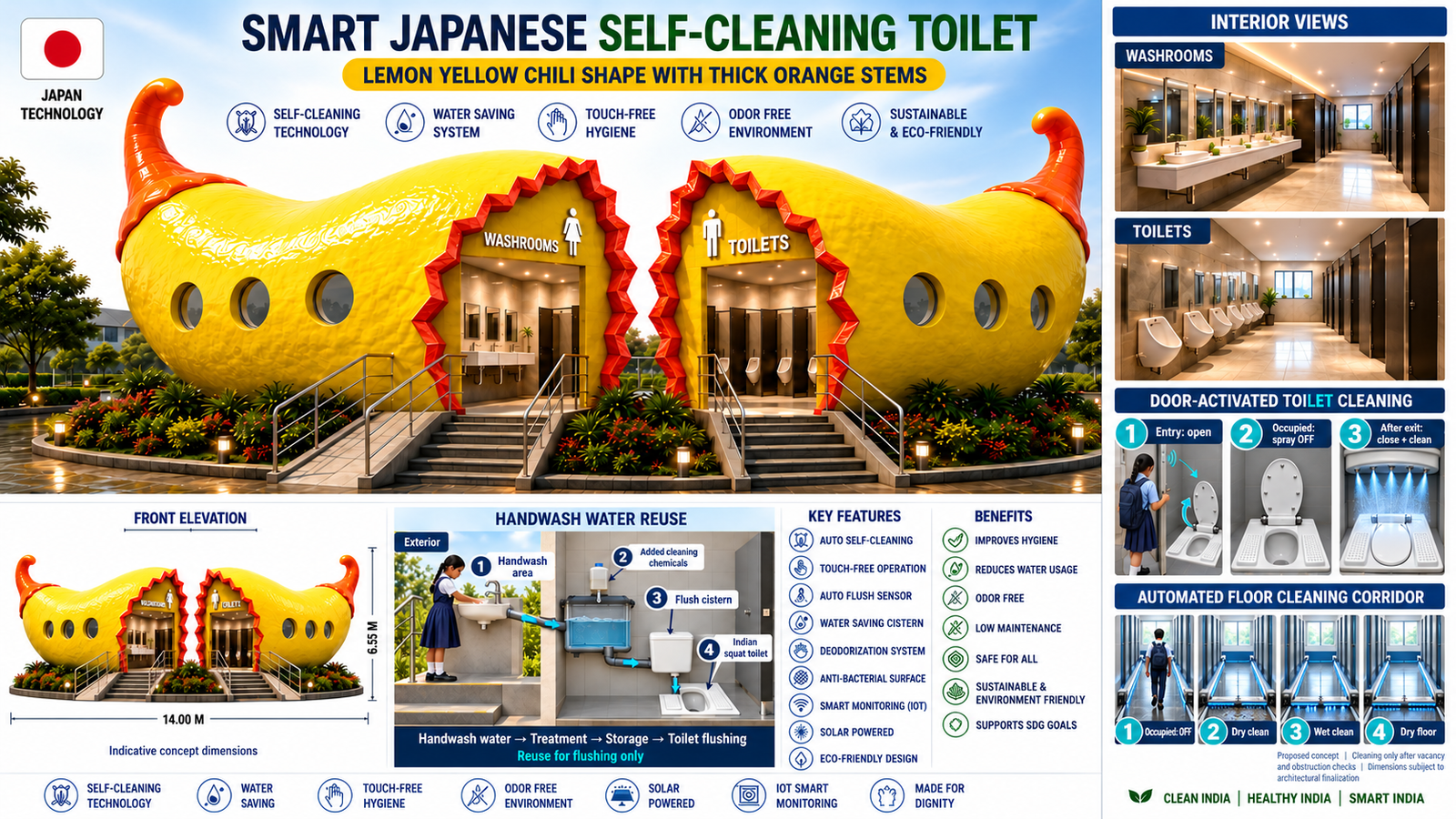
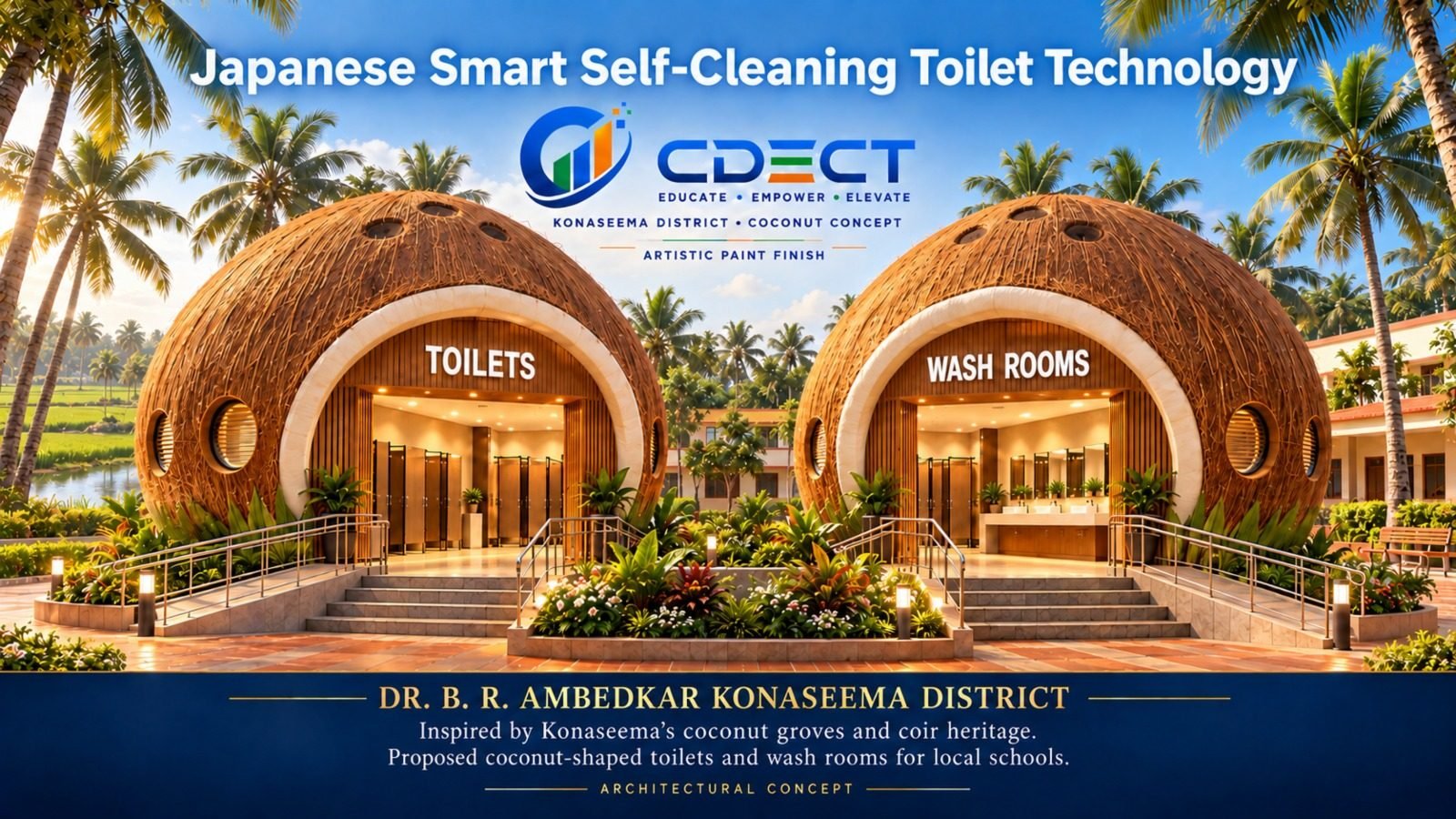
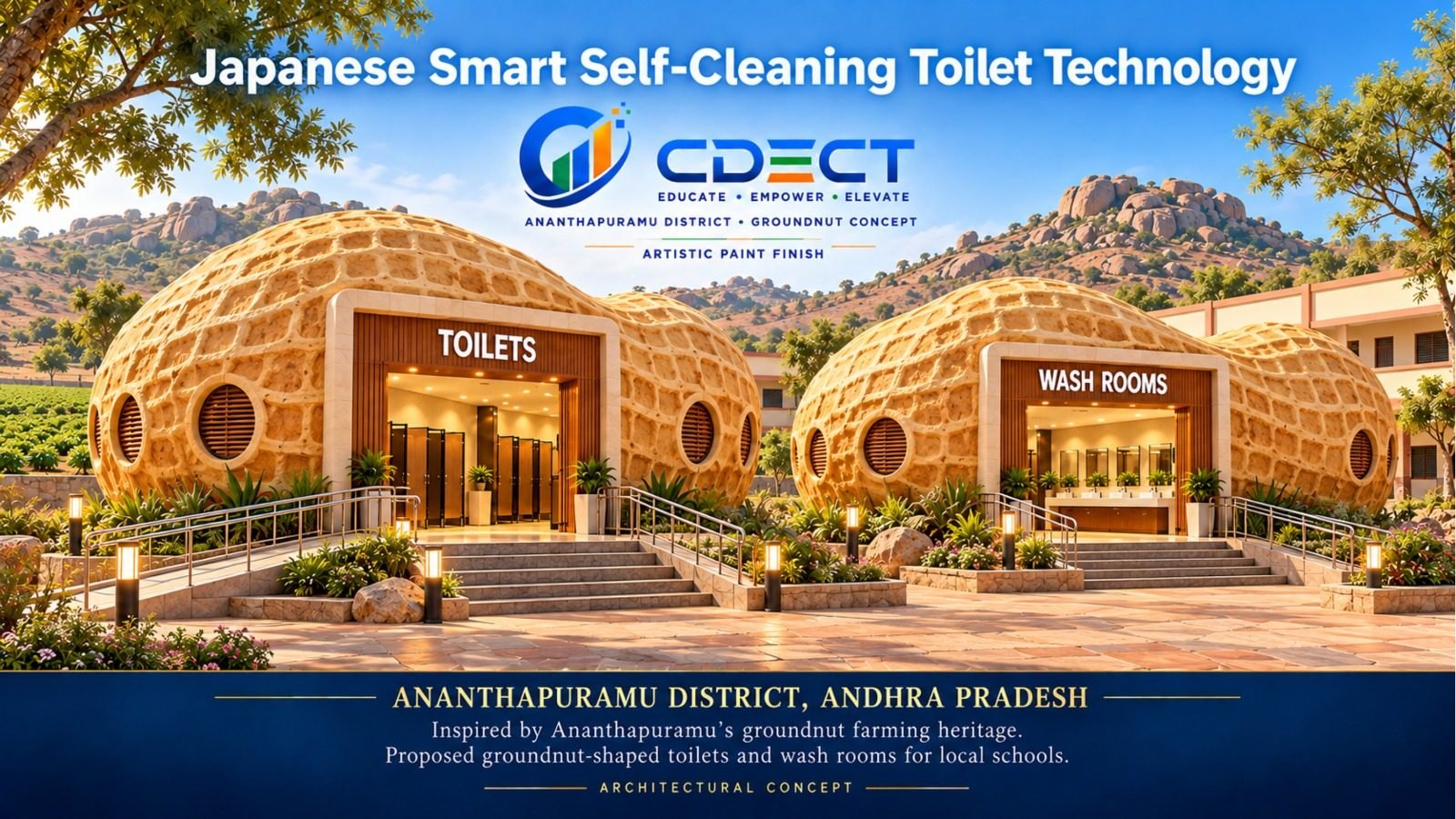
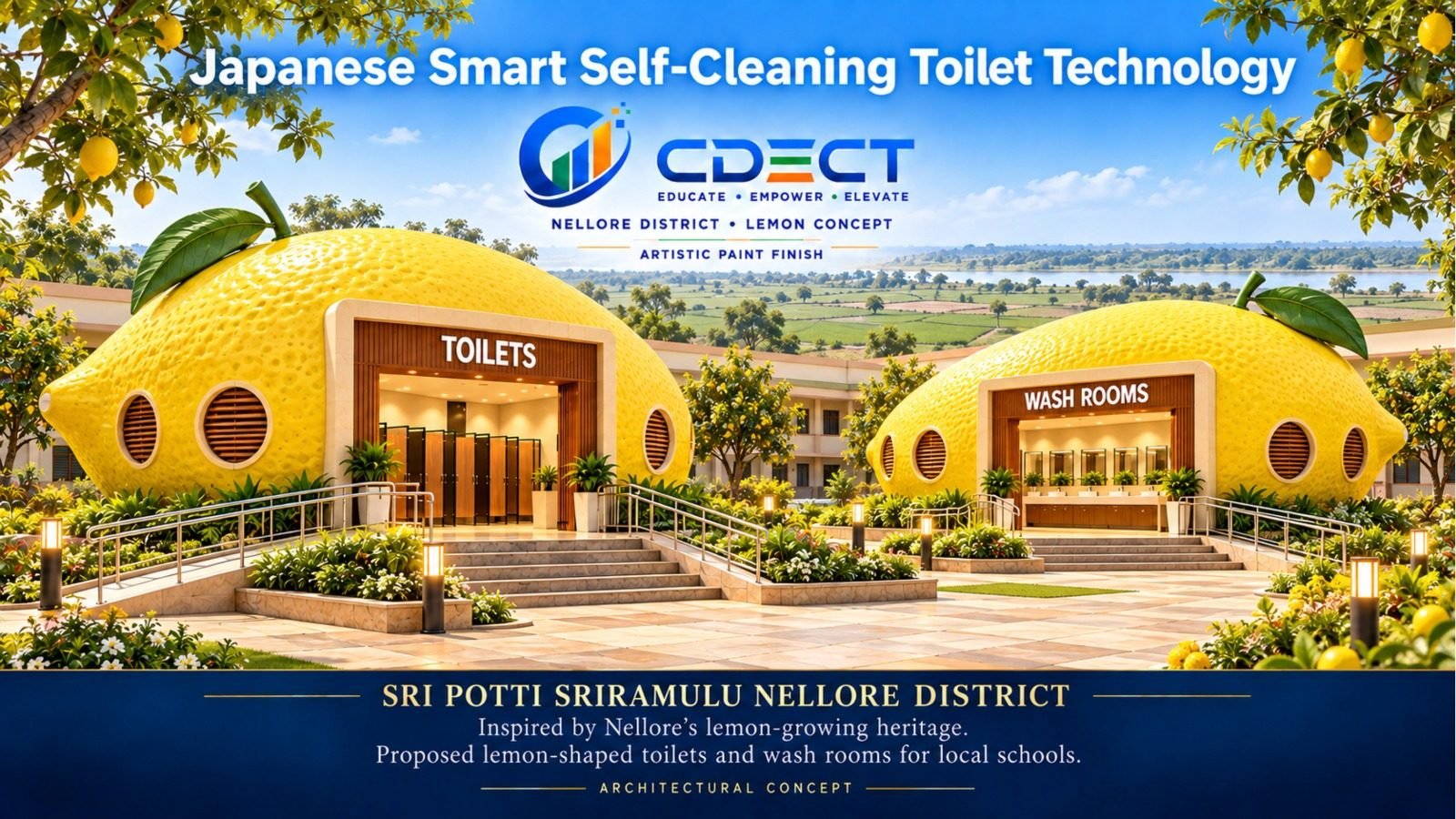
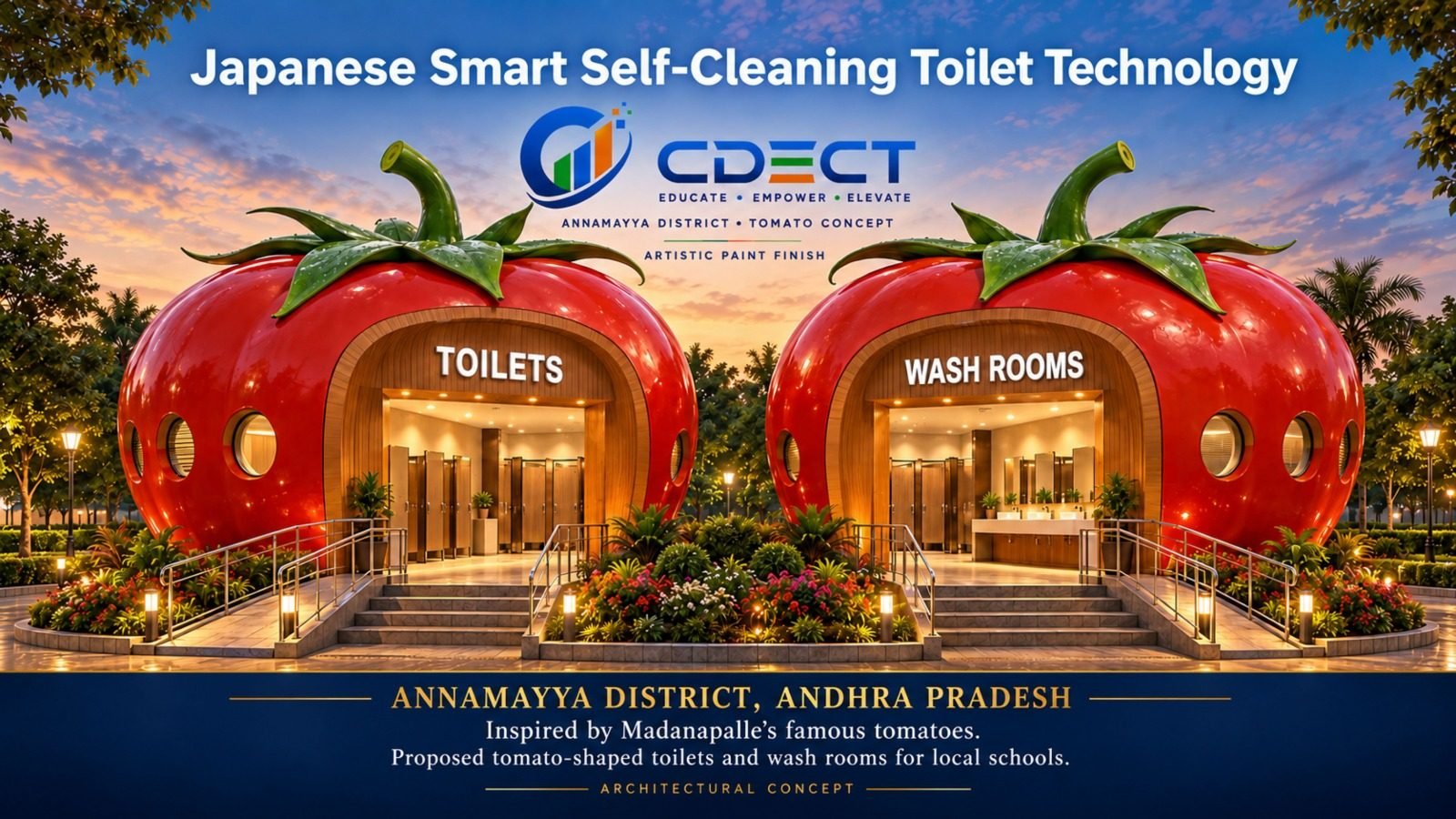
CDECT Japanese Smart Self-Cleaning Toilet Technology — twin yellow chilli design. Proposed project.Smart Japanese Self-Cleaning Toilet — indicative concept 14.00 m × 6.50 m, automation and water-reuse features. Proposed concept.
01 Flagship project
ProposedStarting soonSchool sanitation
Japanese Smart Self-Cleaning Toilets — Twin Yellow Chilli Design, Guntur
CDECT is introducing Japanese self-cleaning smart toilet technology for schools and residential hostels — so every child has a washroom that stays clean, safe and dignified every day of the year.
The Guntur pilot
The iconic architecture is a twin yellow chilli (mirchi) form that honours Guntur’s famous chillies: one block for Washrooms and one for Toilets, facing each other as a campus landmark students and the community will recognise as their own.
The first project is at the Boys Residential School, Adavitakkellapadu, Guntur District, Andhra Pradesh. Permissions have been granted. CDECT has commenced preliminary site works and is preparing for foundation construction.
This is a proposed / starting-soon pilot. Concept images and indicative dimensions describe the planned design; they are not photographs of a finished building. Unit counts, costs and completion dates will be published only from signed project records.
The planned system combines better fixtures, automatic cleaning, water reuse and smart monitoring — with child safety first: no cleaning cycle while occupied, and never any cameras inside toilets.
1
Self-cleaning & touch-free
Auto flush sensors and touch-free operation where fixtures allow, so students need not touch dirty surfaces.
2
Door-activated cleaning
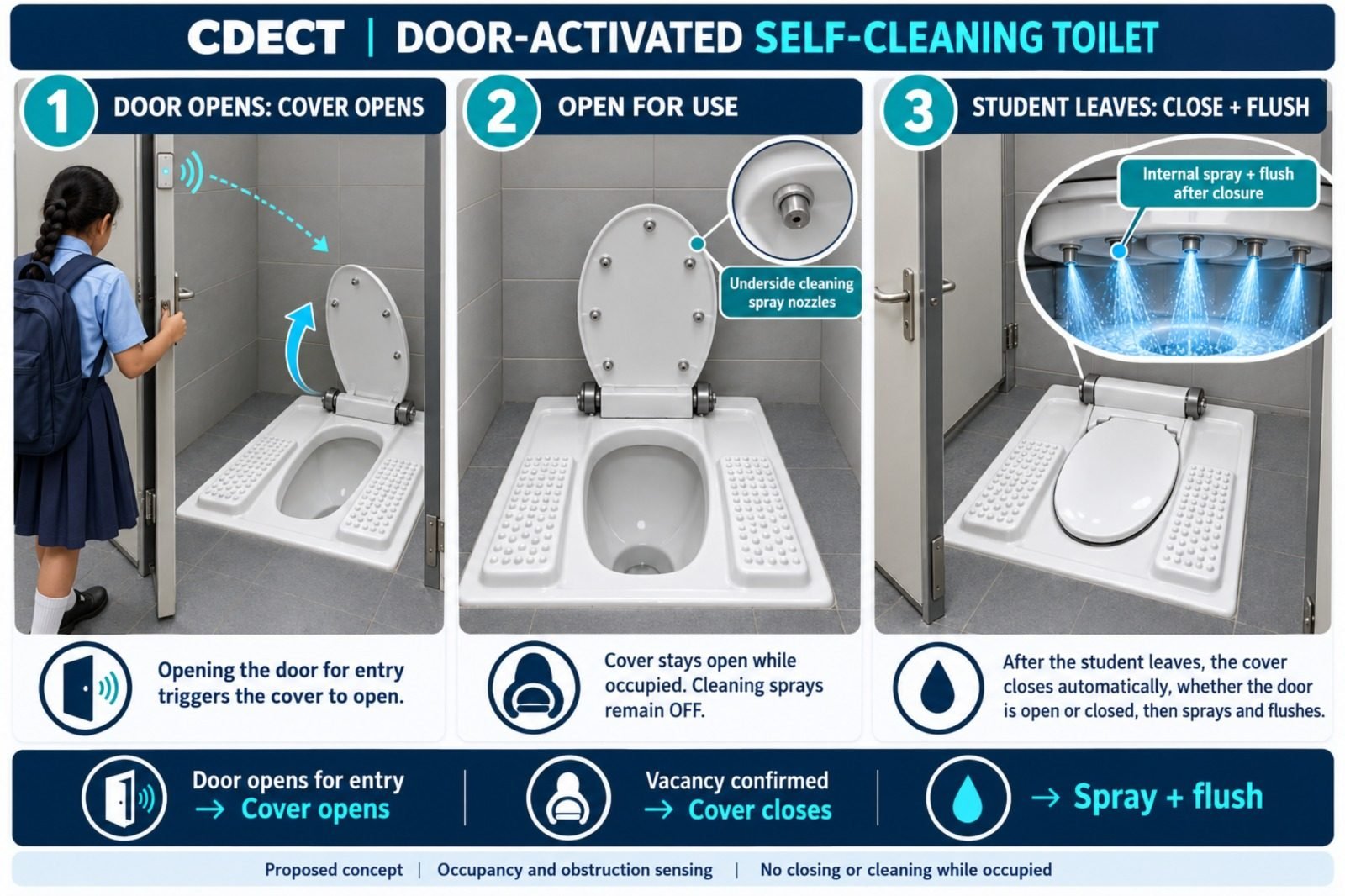
On entry the cover opens; while occupied, spray stays off; after exit the cover closes and a metered clean-and-flush cycle runs.
3
Automated floor corridor
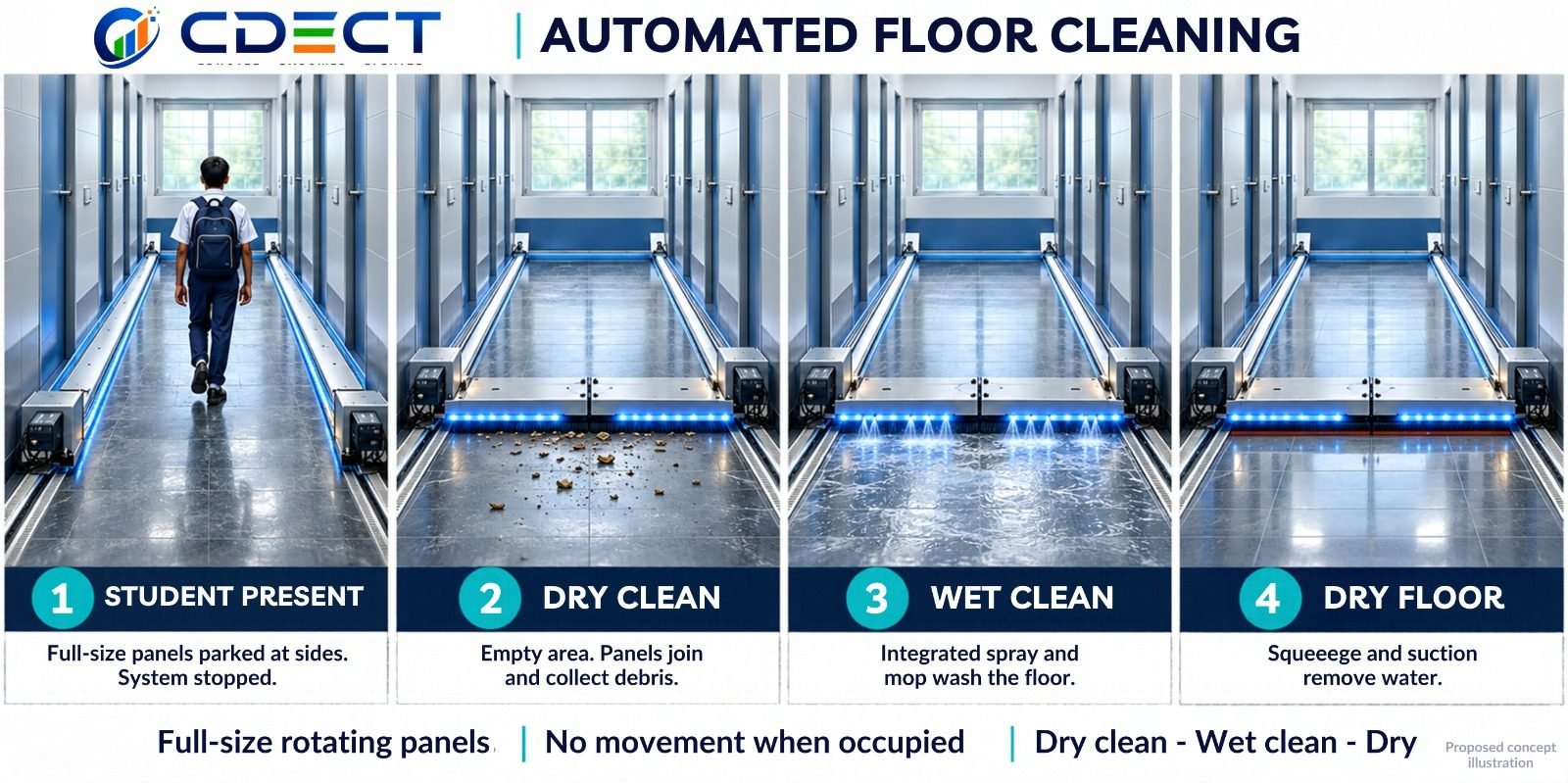
When empty: dry clean → wet clean → dry floor. When occupied, cleaning stays off.
4
Handwash water reuse
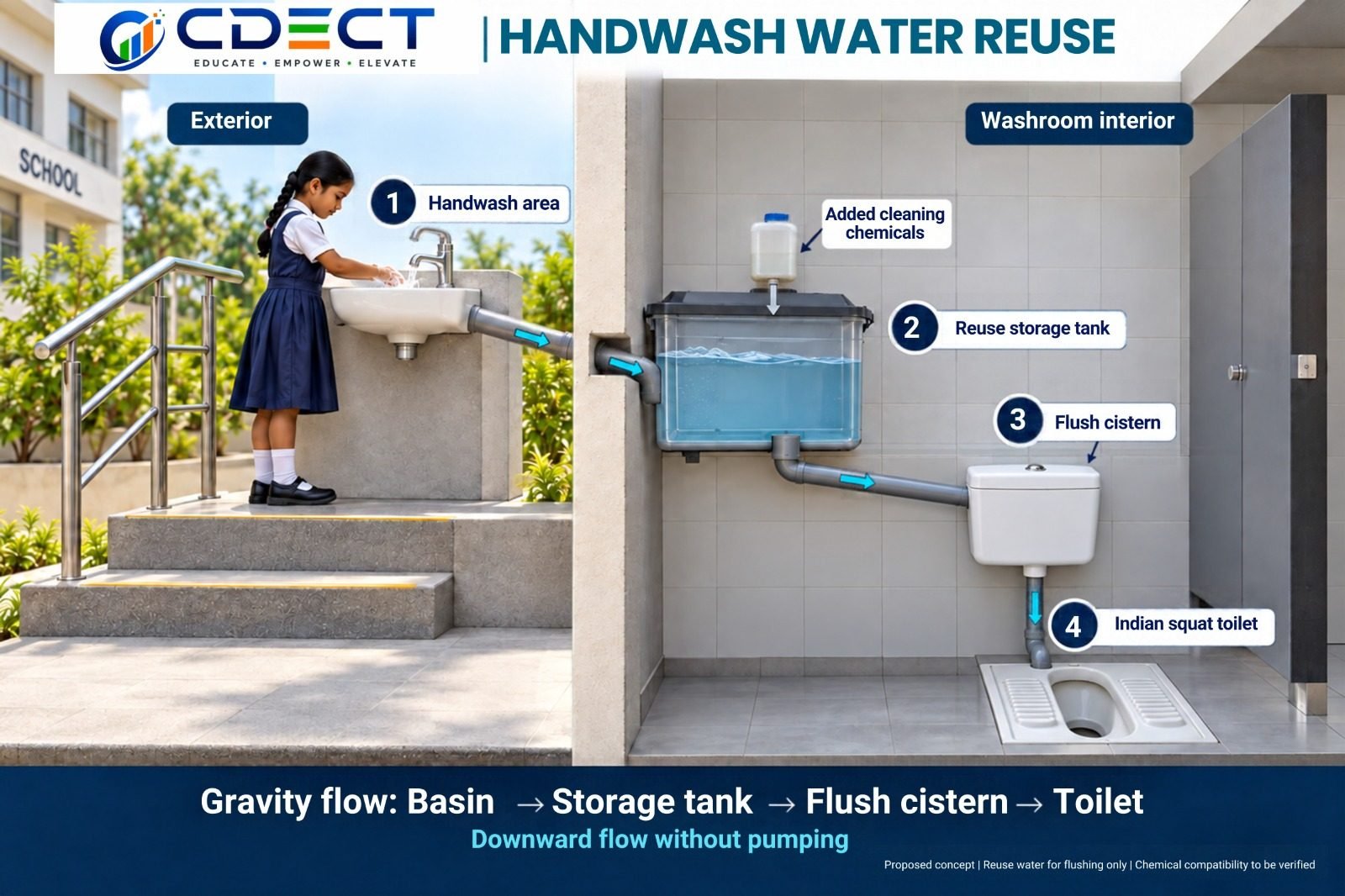
Handwash → treatment → storage → toilet flushing only, to save fresh water.
5
Odour-free & anti-bacterial
Efficient cisterns, deodorisation and anti-bacterial surfaces planned for daily use.
6
Solar & IoT monitoring
Solar support and usage/fault monitoring for caretakers — so facilities keep working after handover.
7
Eco-friendly dignity
A washroom children are proud to use, not forced to avoid — sustainable and made for dignity.
⌀
Indicative size
Twin-chilli block concept: 14.00 m × 6.50 m, subject to architectural finalisation.
02 Across Andhra Pradesh
District-inspired designs
The same smart-sanitation technology can take a local form in each district — so every campus landmark feels familiar. These are architectural concept visualisations for school toilets and wash rooms.
Illustrative concepts. Digitally created architectural visualisations — not photographs of installed CDECT facilities. The Guntur pilot uses the twin yellow chilli design shown above.
4Present projects
3Upcoming projects
65Institutions surveyed on the ground
3Districts covered by surveys
03 Washrooms & toilets
Sanitation automation — planned features
Step-by-step visuals of the planned door-activated cleaning, floor-cleaning corridor and handwash water reuse. These are proposed concepts for the Guntur pilot and future school sites.
01
Door-activated toilet cleaning
Entry opens the cover for use. While occupied, cleaning spray stays off. After exit, the cover closes and a metered spray-and-flush cycle runs — only when the cubicle is empty.
02
Automated floor cleaning corridor
When the corridor is occupied, cleaning stays off. When empty: dry clean to collect debris, wet clean with integrated spray and mop, then dry floor with squeegee and suction.
03
Handwash water reuse for flushing
Handwash water is treated and stored, then reused only for toilet flushing: handwash → treatment → storage → flush cistern. Designed for water saving without pumping where gravity allows.
Planned feature set
Self-cleaning & auto flush sensors
Metered flush and rinse cycles start only after occupancy sensors confirm the cubicle is vacant.
Touch-free hygiene
Sensor or push taps, soap at child height, and touch-free operation planned wherever fixtures allow.
Door-activated seat cleaning
Cover opens on entry, spray stays off while occupied, then closes and cleans after exit.
Automated floor cleaning
Corridor panels: dry clean → wet clean → dry floor — only when the space is empty.
Water saving & reuse
Handwash water reused for flushing after treatment and storage; water-efficient cisterns.
Odour-free & anti-bacterial
Deodorisation and anti-bacterial surfaces planned so washrooms stay usable and dignified every day.
Solar powered
Solar support is part of the proposed design so key systems can run with lower grid dependence.
IoT smart monitoring
Planned usage and fault monitoring for caretakers — no cameras inside toilets, ever.
Child safety is non-negotiable: no cleaning cycle while occupied, low-voltage sensors outside the wet zone, RCD protection, fail-safe manual flush, and never any cameras inside toilets. Concept images are illustrative.
04 Our motives
Focus areas that guide every project
CDECT’s work sits under six programme areas — plus integrated programmes that bring a whole school together. Every project on this page maps to one of these motives.
First Smart Washroom unit starting at Boys Residential School, Adavitakkellapadu, Guntur — twin yellow chilli design; permissions granted; preliminary site works commenced.
Structured ground surveys documented at 62 Tribal Welfare institutions in October 2025, covering toilets, water, kitchens, classrooms, hostels, electrical safety, health and digital access.
Integrated proposal (Ref. CDECT/SED/STATE/2026-27) for survey-based development of government schools and welfare hostels across the six programme areas.
Social Welfare, Tribal Welfare and BC Welfare Departments, Andhra Pradesh
Action plans, tentative budgets and Detailed Project Reports prepared for toilet construction and maintenance in welfare institutions, with representations to the departments.
Request dated 18-05-2026 for allotment of the self-defence training programme in government schools through an Expression of Interest.
View project
How to read this: “Surveyed” means a campus was documented, not improved. “Proposed” means a proposal or DPR was prepared, with no approval on record. “Approved in principle” means a written approval exists, subject to conditions. Concept images on this page are illustrative.
Partner with CDECT
Fund a Smart Washroom — or the next school plan
CSR partners can register for a dedicated dashboard with funding stages, beneficiaries and impact reports. Individuals can support a school directly.